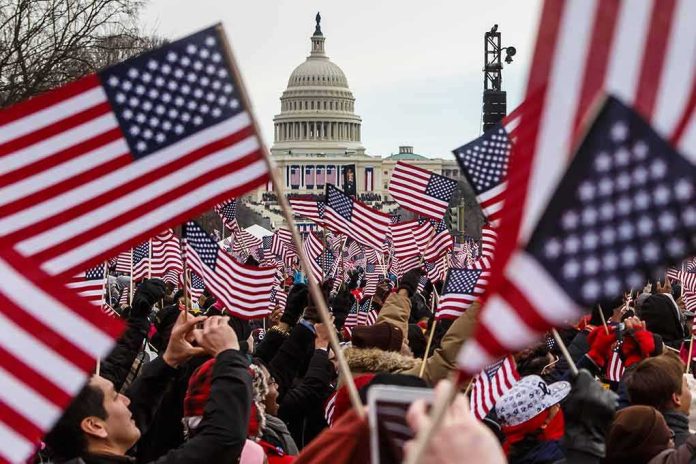
America’s 250th birthday is already stirring the oldest argument in the republic: whether public prayer at the National Mall is heritage, worship, or political theater.
Quick Take
- Thousands gathered on the National Mall for Rededicate 250, a prayer and worship event tied to the nation’s semiquincentennial celebration [2].
- Organizers framed the gathering as a public rededication of the country to God, not as a neutral civic ceremony [2].
- Supporters saw a restoration of America’s religious roots; critics saw a sharper blend of faith and state symbolism [1].
- The event drew major political figures, visible security, and a national debate about what kind of country America is becoming [1][3].
A Prayer Rally Built for a Historic Anniversary
Rededicate 250 turned the National Mall into a stage for prayer, testimony, worship music, and patriotic symbolism. Freedom 250, the group behind the event, described it as a “historic gathering” with Scripture, testimony, prayer, and a rededication of the country as “One Nation to God” [2]. Coverage from the field described crowds filling the Mall for a daylong faith rally connected to America’s 250th birthday [1].
The scale mattered because the event was not a small devotional meeting tucked away in a church parking lot. It occupied one of the most symbolic public spaces in the country, with the Washington Monument nearby and thousands of attendees moving through a setting that instantly carried civic weight. That combination gave the gathering its force. A prayer meeting becomes something larger when it stands in the shadow of the federal imagination .
The Organizers Chose Religious Clarity Over Civic Neutrality
Freedom 250 did not hide the event’s intent. Its own materials invited Americans to come together in prayer and worship ahead of the nation’s 250th birthday and described the day as a collective act of gratitude and rededication [2]. That directness is why supporters found the event refreshing. It did not pretend religion was absent from American history. It put religion front and center and treated that choice as a strength rather than an embarrassment [2].
That framing fits a familiar American pattern. The country has long made room for public acknowledgments of faith, especially during moments of national reflection. From a common-sense conservative view, the event’s appeal is easy to understand: many Americans believe the nation’s moral vocabulary still depends on prayer, humility, and divine accountability. The deeper question is not whether religion belongs in the public square. It is whether the public square can still speak honestly about the beliefs that shaped it [2].
Critics Saw A Christian Message In A Federal Civic Space
Critics focused on the event’s religious exclusivity and its setting on federally controlled ground. NBC4 Washington reported that the program featured Christian leaders and a rabbi while notably excluding representatives from other faiths such as Islam, Buddhism, or Hinduism . That detail sharpened the constitutional criticism. The objection was not to prayer alone, but to the perception that a public national venue was being used to elevate one religious tradition as the voice of the country .
A taxpayer-funded 9hr “Christian-centered” prayer event on our national mall?
That’s DEFINITION endorsing a national religion, which is PROHIBITED by the 14th amendment
And while you’re cherry-picking from the founders’ words… pic.twitter.com/GqZ7aRwjeK
— Ima Private Person (@ImaPrivate) May 18, 2026
That concern has real political force because symbolism travels faster than legal nuance. When the stage, the music, the speakers, and the script all point in one direction, the public does not debate the fine print first. It reads the message. Supporters call that clarity. Opponents call it exclusion. Both reactions make sense, which is why the event landed as more than a rally. It became a test of whether Americans still agree on the difference between national memory and national endorsement [3].
Political Power Gave The Event Extra Heat
The guest list added fuel. Reporting identified President Trump, Cabinet officials, and Republican lawmakers among the prominent voices linked to the event [3]. That matters because religious gatherings can become political lightning rods the moment elected power enters the frame. Even when the message centers on prayer, the presence of national leaders changes the meaning. For supporters, it signals seriousness. For critics, it raises the suspicion that state influence and religious symbolism are becoming harder to separate [3].
The visible security presence also shaped the atmosphere. News coverage noted park police, Drug Enforcement Administration agents, and Metropolitan Police Department officers across the Mall [1]. That kind of coordination made the event feel less like an ordinary rally and more like a major national occasion. It also underscored a simple truth: when an event gathers thousands on sacred civic ground and draws top political figures, it stops being merely ceremonial. It becomes a statement about identity, power, and who gets to define America’s story [1][3].
What This Event Reveals About America’s 250-Year Argument
Rededicate 250 was not just about one day of prayer. It exposed how divided Americans remain over the public meaning of faith. Supporters see a nation remembering its moral inheritance. Critics see a Christian-coded message crossing into civic territory that belongs to everyone. The facts in the record support both reactions: the event was openly devotional, and it was also staged on one of the most symbolic public spaces in America [2].
The argument will not end with this rally, because the semiquincentennial is only beginning. More celebrations, more speeches, and more symbolic battles will follow. The deeper issue is whether Americans want their 250th birthday marked by sanitized consensus or by an unapologetic return to the traditions many believe built the country. That question, once asked in public, rarely leaves quietly [1][2][3].
Sources:
[1] YouTube – Thousands gather at National Mall for “Rededicate 250” as US …
[2] Web – Rededicate 250: A National Jubilee of Prayer, Praise & …
[3] YouTube – U.S. leaders to speak at ‘Rededicate 250’ prayer event …