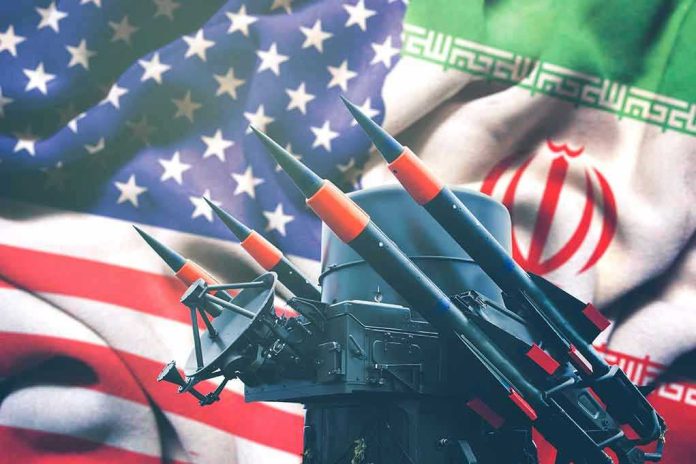
Americans are watching a new Middle East war unfold—and polls suggest they still can’t tell you what the U.S. is fighting for.
Quick Take
- Polling indicates many Americans disapprove of the Iran war and say the administration has not clearly explained U.S. goals.
- President Trump has described multiple objectives—stopping a nuclear threat, countering missiles, and pursuing regime change—without clear prioritization.
- Voters increasingly believe the conflict benefits Israel more than the United States, complicating public support and congressional oversight.
- The Pentagon’s reported $200 billion funding request heightens taxpayer scrutiny as Americans expect a longer war than initially suggested.
Polling shows a widening gap between war messaging and public understanding
CBS News polling reports that most Americans disapprove of the war with Iran and say President Trump has not clearly explained what the United States is trying to achieve. That kind of confusion is not a small communications problem; it is a democratic accountability problem, because sustained military operations require public consent and congressional oversight. When objectives are unclear, voters struggle to judge progress, costs, and whether the mission matches U.S. interests.
Disagreement is also shaped by partisanship, but the data still points to broad uncertainty. Polling summarized by the Angus Reid Institute indicates Americans diverge sharply on whether the war makes the country safer, with many believing it does not. The same research shows only a small share of Americans expect a quick conflict, while far more anticipate months or even years. Those expectations matter because timelines drive everything from troop posture to budget choices.
Three stated goals—nukes, missiles, and regime change—create mixed signals
The administration’s public case for action includes preventing Iran from developing nuclear weapons and countering Iranian missile threats, alongside talk of regime change. Each goal implies a different strategy, timeline, and definition of victory. Preventing a nuclear breakout can involve intelligence, sanctions, and targeted strikes; neutralizing missile threats can mean sustained campaigns against launch sites; regime change is a far larger political project that historically has carried major uncertainties.
The public’s confusion becomes easier to understand when the objectives blur together. Angus Reid’s reporting also highlights Trump’s earlier promises that he would “stop wars” and avoid new ones, which voters now compare to the reality of “Operation Epic Fury,” reported as beginning February 28, 2026. A president can argue that deterrence requires force, but credibility depends on explaining why war is necessary, what ends it, and what happens if the stated goals prove unattainable.
Support softens when voters think the benefits flow elsewhere
Data for Progress polling indicates that a majority of likely voters believe the war benefits Israel more than the United States, while a smaller share believes it benefits the U.S. more. That perception does not prove the policy is wrong, but it does reveal a political vulnerability: Americans tend to support foreign engagements when leaders clearly connect them to U.S. security and constitutional responsibilities, including defending the homeland and protecting American service members.
This is where messaging meets governance. If the administration’s goals are framed in broad moral terms but the public hears an open-ended commitment abroad, support can erode quickly—especially among voters who have lived through Iraq and Afghanistan. For conservatives who prioritize limited government, fiscal restraint, and America-first clarity, the immediate question is not whether Iran is dangerous; it is whether the mission is defined, lawful, funded transparently, and realistically scoped.
Congress faces a high-stakes funding test as “boots on the ground” questions grow
Reuters/Ipsos reporting referenced in the research shows Americans are skeptical about ground troop deployment, while multiple surveys summarized across outlets find majorities opposing “boots on the ground.” Trump has said ground troops could be deployed “if necessary,” but the conflict has been conducted primarily through air operations so far. That distinction matters because public tolerance changes dramatically when a war shifts from strikes and deterrence to occupation-style commitments.
Meanwhile, the Pentagon has requested $200 billion from Congress for Middle East operations, according to the reporting summarized in the research. That figure turns a strategic debate into a household-budget debate, especially after years of inflation fears and frustration with Washington spending. Constitutional oversight requires lawmakers to ask basic questions: what is the end state, what metrics define success, and what is the plan if regime change proves unreachable without escalation?
What the polling can and cannot prove right now
Polls cannot tell Americans whether the strategy is correct; they can tell leaders whether the strategy has been explained well enough for citizens to consent. The available data consistently indicates the public sees unclear goals, expects a longer war than initially projected, and worries about safety and casualties. If the administration wants durable support, the clearest path is a tighter definition of objectives, sequencing, and limits—before pressure builds for broader war powers and bigger spending.
With Congress considering major funding and the public divided on whether this conflict makes America safer, clarity is not optional. Conservative voters who value national security also value truth in mission statements, restraint in spending, and a clean chain of accountability. If the goal is preventing a nuclear-armed Iran, that case can be made. If the goal is regime change, voters deserve an honest explanation of the costs, risks, and constitutional guardrails.
Sources:
Angus Reid Institute: Iran-U.S. polling on war, invasion, Israel, and Trump
Common Dreams: Israel-Iran war coverage and polling discussion
NBC16: Majority of Americans think the U.S. will put boots on the ground in Iran, poll
CBS News video: Most Americans feel Trump not clearly explained U.S. goals in Iran, poll shows