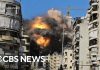
After years of “diplomacy first” talk, Operation Epic Fury is forcing the country to confront a harder reality: stopping Iran’s nuclear and missile threat now comes with major combat risks and real American casualties.
Story Snapshot
- U.S. and Israeli forces launched Operation Epic Fury on Feb. 28, 2026, striking Iranian command nodes, air defenses, missile sites, drones, and airfields as part of a stated push to cripple Iran’s war-making capacity.
- U.S. briefings and reporting say the campaign has hit more than 2,000 targets; early waves reportedly used heavy bombers and precision munitions, with new low-cost one-way drones also cited in official materials.
- By early March, the Pentagon acknowledged 6 U.S. service members killed and 18 wounded, underscoring that “over-the-horizon” air power still carries serious costs when Iran shoots back.
- Senate Republicans defeated an effort to constrain the operation, while critics raised questions about timing following Geneva nuclear talks and about civilian harm claims that remain hard to independently verify.
What Operation Epic Fury Is Targeting—and Why It Started Now
U.S. Central Command announced that U.S. forces launched Operation Epic Fury in the early hours of Feb. 28, 2026, with Israel participating in the broader push to suppress Iranian air defenses and strike military infrastructure. Reported target sets include IRGC command centers, air defense systems, missile launch capability, drones, and airfields—aimed at reducing Iran’s ability to threaten U.S. personnel, allies, and shipping while also limiting any path toward a nuclear weapon.
U.S. statements and reporting describe heavy, sustained air operations and the massing of American combat power across the region, including major aircraft presence and elevated force protection at U.S. bases. The Defense Department’s published fact materials describe a high operational tempo in the first 72 hours and continued strikes afterward, while acknowledging that the mission’s scale is unusual for the region in recent years. Officials have framed the operation as focused on degrading key systems rather than occupying territory.
Battlefield Reality: Casualties, Uncertainty, and the Ground-Troops Question
Military reporting in early March confirmed 6 U.S. troops killed and 18 service members injured during the operation, a sobering turn from initial statements that emphasized successful defensive interceptions during Iran’s early counterattacks. Senior commanders warned publicly that major combat can produce additional losses even when the U.S. controls airspace and holds decisive advantages in precision strike. Pentagon messaging has not ruled out ground action, keeping uncertainty alive for families watching closely.
Iranian casualty totals and damage claims remain contested. Iranian officials have issued figures that rose from the hundreds to more than a thousand, and some reports cited allegations of significant civilian deaths, including children, tied to a strike location. Independent confirmation is limited, and responsible readers should treat precise numbers as provisional during an active campaign. What is clear is that the operation’s intensity is generating global scrutiny while the U.S. emphasizes continued dominance in the air.
Congress, Constitutional War Powers, and Why Voters Are Watching Closely
On Capitol Hill, a Senate challenge aimed at limiting or rebuking the operation failed, with Republicans closing ranks behind President Trump as Democrats pressed war-powers arguments. The constitutional tension is familiar: Americans want security and decisive action, but they also expect transparency, clear objectives, and accountability for decisions that place service members in harm’s way. Supporters argue the executive must act swiftly against an imminent threat; critics argue timing and scope demand tighter legislative oversight.
The Six Questions Hanging Over the Endgame
Six uncertainties now shape what victory actually looks like: whether Iran can sustain retaliation through missiles, drones, or proxies; whether U.S. air defenses and interceptor stocks hold up under prolonged pressure; whether allies materially support the mission or stand aside; whether leadership decapitation and infrastructure strikes translate into lasting capability loss; whether escalation pulls in more actors; and whether post-strike instability creates a new security vacuum rather than a durable deterrent.
For conservative Americans who are tired of weak signaling, endless negotiations, and global forums that rarely protect U.S. interests, the core metric is straightforward: does this operation measurably reduce the missile and nuclear threat without dragging the U.S. into another open-ended Middle East commitment? Early briefings highlight scale and momentum, but the casualty count and unresolved endgame questions prove the stakes are real. The next weeks will test strategy, resources, and resolve.
Sources:
https://heathercoxrichardson.substack.com/p/march-3-2026
https://internationalpolicy.org/publications/epic-fury-international-law/
https://www.military.com/deployment/honor-fallen-of-operation-epic-fury.html
https://www.war.gov/Spotlights/Operation-Epic-Fury/
https://media.defense.gov/2026/Mar/03/2003882557/-1/-1/1/OPERATION-EPIC-FURY-FACT-SHEET-260303.PDF
https://defense-update.com/20260303_epic-fury.html
https://www.fdd.org/in_the_news/2026/03/02/the-significance-of-operation-epic-fury/