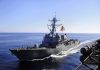
America’s naval firepower faces a devastating blow as the U.S. Navy plans to eliminate 2,080 Tomahawk missile launch capabilities by 2030, crippling our ability to counter China and Russia at a time when peer adversaries are rapidly expanding their arsenals.
Story Snapshot
- Retiring four Ohio-class guided missile submarines and Ticonderoga-class cruisers eliminates 2,080 vertical launch cells for Tomahawk missiles by 2030
- Columbia-class submarine replacements are delayed due to industrial production failures and cost overruns at shipyards
- National security experts warn the firepower gap threatens deterrence against China and Russia in the Pacific
- Defense analysts recommend extending aging Ohio-class submarines despite hull fatigue risks to maintain strike capability
Critical Firepower Gap Threatens Pacific Deterrence
The U.S. Navy faces a looming crisis as planned retirements strip away massive conventional strike capacity. Four Ohio-class guided missile submarines are scheduled for retirement in 2027, eliminating 616 vertical launch system cells capable of firing Tomahawk cruise missiles. Combined with Ticonderoga-class cruiser retirements by 2030, the Navy loses 2,080 VLS cells total—each SSGN carries 154 Tomahawks across 22 modified tubes. This represents firepower equivalent to multiple carrier strike groups, precisely when China expands its naval presence and Russia threatens renewed aggression.
Biden-Era Industrial Failures Delay Replacements
Production delays on Columbia-class ballistic missile submarines and Virginia-class Block V attack submarines expose the industrial base weaknesses created under previous administrations. The Columbia-class first boat, USS District of Columbia, targets 2030 fleet entry but faces persistent setbacks. Virginia Block V submarines with Virginia Payload Modules—83-foot extensions adding 28 VLS tubes—suffer production instability at struggling shipyards. These delays force reliance on 42-year-old Ohio-class hulls approaching metal fatigue limits, requiring costly reactor refits that strain budgets while leaving gaps in nuclear triad coverage.
Strategic Necessity Demands Life Extensions
National security expert Steve Balestrieri, a former Special Forces operator, labels hull extensions a strategic necessity until production stabilizes. General Anthony Cotton, U.S. Strategic Command Commander, advocates expanding the SSBN fleet beyond 12 boats to maintain nuclear deterrence. The four converted Ohio SSGNs—USS Ohio, Michigan, Florida, and Georgia—provide stealthy, survivable strike capability with special operations support that cannot be quickly replaced. Their conversions from ballistic missile submarines occurred between 2002 and 2008 following the 1994 Nuclear Posture Review, which reduced SSBN requirements to 14.
Congress Must Act to Close Capability Shortfall
The firepower deficit directly undermines America’s ability to respond to Pacific threats while maintaining nuclear second-strike assurance. Short-term consequences include weakened conventional strike options against Chinese targets by 2027. Long-term vulnerabilities emerge if Columbia-class delays compromise the nuclear triad’s sea leg, emboldening adversaries. Extending Ohio-class service requires congressional funding for hull inspections and reactor maintenance, but this represents essential investment compared to the strategic costs of capability gaps. The Trump administration inherited a shipbuilding crisis created by years of procurement mismanagement and must prioritize stable production to counter peer competitors threatening American interests.
2,080 Tomahawk Missiles Gone: The U.S Navy Can’t Retire the Ohio-Class Nuclear Missile Submarines Nowhttps://t.co/jmuEYoiOvG
— 19FortyFive (@19_forty_five) March 3, 2026
This situation exposes the danger of allowing defense industrial capacity to atrophy through bureaucratic inefficiency and short-sighted budget decisions. Maintaining naval superiority requires immediate action to keep aging platforms operational while accelerating replacement programs. The alternative—conceding conventional and nuclear strike advantages to China and Russia—contradicts every principle of peace through strength that has protected American security for generations. Patriots understand that projecting power deters aggression, and eliminating 2,080 missile cells invites the very conflicts a strong deterrent prevents.
Sources:
Ohio-class submarine – Wikipedia
Ohio-class – Naval History and Heritage Command
Ohio-Class Submarines History – Popular Mechanics
SSGN Ohio Class Guided Missile Submarine – Military.com