
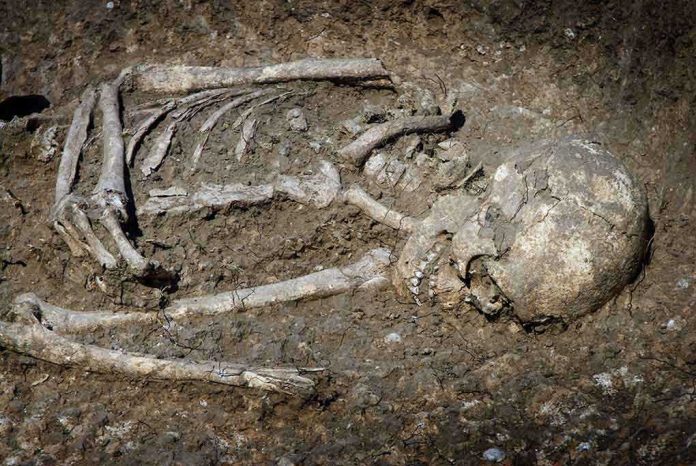
New evidence from a 2,800-year-old mass grave in Serbia reveals a chilling pattern of deliberate violence against women and children that challenges everything archaeologists thought they knew about prehistoric warfare.
Story Snapshot
- Archaeological excavations in northern Serbia uncovered remains of 77+ individuals, with 87% of adults being women and 40 children aged 1-12, all violently killed via bludgeoning and stabbing approximately 2,800 years ago
- Genetic analysis proved victims were unrelated strangers from multiple settlements, ruling out typical village raids and indicating targeted capture and execution to terrorize communities
- The ritual burial with valuables and animal offerings distinguishes this massacre as a deliberate power assertion during territorial conflicts in the early Iron Age
- Findings published in Nature Human Behaviour challenge romanticized views of prehistoric societies and reveal sophisticated terror tactics used to control landscapes during post-Bronze Age recovery
Deliberate Targeting of Vulnerable Populations
Researchers at the Gomolava archaeological site in northern Serbia discovered a mass grave containing more than 77 individuals who died violently around 800 BCE. The demographic composition shocked investigators: 87% of the adults were women, alongside 40 children aged 1-12 and 11 adolescents. Barry Molloy, Associate Professor at UCD School of Archaeology and co-lead researcher, stated the findings “genuinely took us by surprise,” noting that reasserting control over landscapes could include widespread and extremely violent episodes. The victims suffered brutal deaths through bludgeoning and stabbing, indicating premeditated violence rather than spontaneous conflict.
Genetic Evidence Reveals Calculated Terror Strategy
Genetic analysis conducted by Hannes Schroeder at the University of Copenhagen provided startling insights into the victims’ origins. The individuals shared no familial relationships, with DNA evidence showing they were not even distantly related at the great-great-grandparent level. Isotopic analysis of their teeth revealed diverse childhood diets, confirming they originated from multiple separate settlements across the region. This evidence directly contradicts the expected pattern of prehistoric mass graves, which typically contain related families from a single village hastily buried after raids. The deliberate collection of unrelated women and children from different communities suggests a coordinated campaign designed to send a grisly message to surrounding populations.
Ritual Elements Distinguish Massacre From Ordinary Violence
The burial itself contained unusual elements that set it apart from typical Iron Age mass graves. Victims were interred with personal possessions including bronze jewelry and ceramics, accompanied by ritual offerings such as a butchered calf, broken grinding stones, and burnt seeds. Dr. Linda Fibiger from the University of Edinburgh interpreted these brutal killings and subsequent commemoration as a powerful bid to balance power relations during a period of intense territorial competition. The bodies were placed in a disused house rather than a hastily dug pit, indicating careful preparation and symbolic significance. These ritual elements suggest the perpetrators intended the site to serve as a lasting monument to their dominance.
Iron Age Territorial Conflicts Drive Unprecedented Violence
The massacre occurred during the early Iron Age in the Carpathian Basin, a period of recovery following the Bronze Age collapse. Communities were reoccupying settlement mounds and constructing fortified mega-forts, intensifying territorial disputes over land and resources. The conflict between settled agricultural groups and mobile pastoralists created conditions for extreme violence as groups reasserted control over strategic landscapes. This discovery illuminates how prehistoric societies employed sophisticated terror tactics comparable to modern warfare strategies. The targeted elimination of women and potential future generations served both immediate tactical purposes and long-term psychological warfare, undermining rival communities’ ability to sustain themselves.
Archaeological Methods Reveal Hidden Historical Patterns
The research team employed multidisciplinary approaches combining traditional archaeological excavation with cutting-edge genetic analysis and isotopic studies. Funded by the European Research Council, the investigation involved institutions including University College Dublin, University of Edinburgh, University of Copenhagen, and the Museum of Vojvodina. The findings, published in Nature Human Behaviour, provide fresh understanding of Iron Age conflict dynamics and challenge assumptions about prehistoric violence being primarily opportunistic or defensive. Molloy emphasized that the non-family demographics rule out village attacks, indicating planned capture and killing for intimidation purposes. This evidence-based reinterpretation demonstrates how advanced scientific methods can overturn long-held archaeological assumptions about ancient societies and their capacity for organized, strategic violence against civilian populations.
Sources:
Iron Age massacre targeted women and children, new research reveals – European Research Council