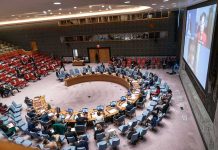
Marco Rubio’s warning from Munich was blunt: global “solutions” are failing, and Americans keep paying the bill while the United Nations delivers excuses.
Quick Take
- Secretary of State Marco Rubio used the Munich Security Conference to criticize the United Nations as ineffective in today’s major crises.
- Rubio argued the post–Cold War belief in borderless global governance produced dangerous “delusions” about nation-states and sovereignty.
- He called for reforming international institutions while pushing a revitalized U.S.-Europe alliance based on reciprocity and realism.
- European leaders publicly welcomed Rubio’s softer tone, even as they emphasized greater European defense independence.
Rubio’s Munich message: the UN “has no answers”
Secretary of State Marco Rubio delivered his address on Feb. 14, 2026, during day two of the Munich Security Conference in Germany, aiming at one of the West’s sacred cows: the idea that big international bodies can manage modern crises. Rubio said the United Nations has “no answers” and has played “virtually no role” on the world’s most pressing problems. He framed his critique as a demand for reform—not a call to scrap diplomacy altogether.
Rubio’s comments landed inside a conference built for alliance maintenance. The Munich Security Conference has served as a major transatlantic forum since 1963, originally focused on Cold War security and now dominated by questions about NATO burdensharing, Ukraine, and institutional credibility. In that setting, Rubio’s speech targeted what many voters back home recognize: high-minded global governance talk can mask failure, while accountability gets diffused across committees, agencies, and unelected bureaucracies.
Reform, not retreat: what Rubio said the U.S. wants
Rubio’s core point was not isolation, but leverage: the U.S. wants alliances and institutions that work, especially when American taxpayers and service members carry disproportionate weight. He emphasized U.S.-Europe cooperation and argued global institutions must be updated for a world that did not turn into a frictionless “end of history.” He also tied institutional paralysis to real-life problems—security breakdowns, instability, and pressure on borders—rather than abstract debates.
The speech also fit the Trump administration’s broader posture: alliances are valuable, but only if partners share responsibilities. Reporting around the conference highlighted that Rubio’s tone toward European allies was more conciliatory than some earlier Trump-era rhetoric, including last year’s pointed remarks from Vice President JD Vance about Europe’s defense spending. That shift mattered because the administration appears to be pairing firmness on outcomes with less theatrical confrontation.
Europe’s reaction: reassurance, plus a push for independence
European leaders responded in a way that showed both relief and caution. European Commission President Ursula von der Leyen described Rubio’s tone as “very reassuring,” according to contemporaneous coverage, while still pressing the case for greater European independence in defense and “digital sovereignty.” UK Prime Minister Keir Starmer likewise spoke of defense “interdependence,” signaling willingness to coordinate while protecting national capabilities. The message from Europe was clear: cooperation is preferred, but dependency is not.
German Chancellor Friedrich Merz set the stage on Feb. 13 by calling for renewed transatlantic trust, and Rubio’s approach appeared designed to meet that moment without backing away from U.S. demands for seriousness and reciprocity. This mix—mend fences, demand results—reflects a practical reality in 2026: deterrence and readiness require allied unity, but unity built on vague commitments tends to collapse when costs show up.
Why border security and national sovereignty stayed central
Rubio also connected security to domestic cohesion, a link many working Americans understand instinctively. In coverage of the speech, he criticized mass migration pressures and derided “climate cult” politics, placing both under a broader argument that elite post–Cold War assumptions weakened nation-states and blurred the meaning of borders. The research does not provide detailed policy proposals from the speech itself, but it clearly shows the themes: sovereignty, cohesion, and institutions measured by outcomes.
Marco Rubio UNLOADS on Useless United Nations in Germany — “Has No Answers” to World’s Biggest Crises https://t.co/IdCIXP6zgX #gatewaypundit via @gatewaypundit
— Roman Smieszek (@RomanSMB1) February 14, 2026
That framing matters politically because it treats border control as a national security and constitutional governance issue rather than a public-relations problem. When institutions can’t enforce core rules—territorial integrity abroad or borders at home—citizens lose confidence, and power drifts toward unaccountable administrators. Rubio’s argument, as described in the sources, is essentially a demand to restore clarity: nations must govern themselves, allies must do their part, and international bodies must earn credibility.
Sources:
Rubio’s speech to European allies takes softer tone
Marco Rubio: US wants an alliance not ‘paralyzed by fear’