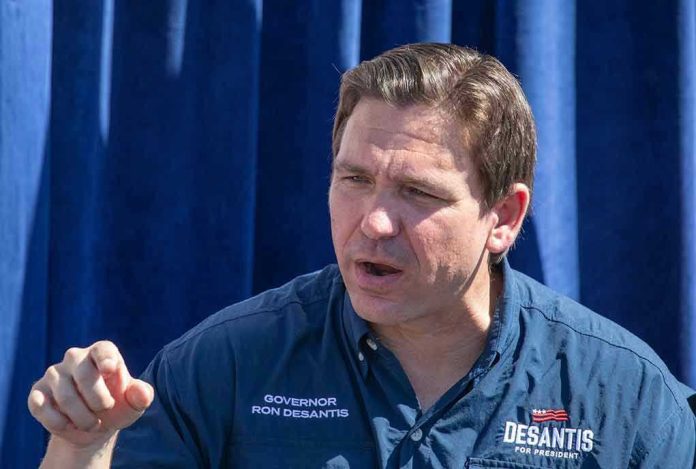
Florida’s governor just branded the nation’s biggest Muslim civil-rights group a “foreign terrorist organization,” setting up a constitutional showdown over who really controls national security and who protects American liberties at home.
Story Snapshot
- Gov. Ron DeSantis signed an order labeling CAIR and the Muslim Brotherhood “foreign terrorist organizations” and cutting them off from Florida state contracts and funding.
- CAIR‑Florida vows to sue, arguing the governor has no legal authority to make foreign terrorist designations and has defamed a U.S.-based civil-rights group.
- The clash tests state power versus exclusive federal authority over Foreign Terrorist Organization designations under the Immigration and Nationality Act.
- The case could shape how far red states can go in confronting groups they view as aligned with hostile Islamist movements.
DeSantis Pushes State Authority To Target Islamist-Linked Groups
Gov. Ron DeSantis signed his executive order in early December 2025, publicly posting it on X and directing Florida’s executive and Cabinet agencies to treat the Council on American‑Islamic Relations and the Muslim Brotherhood as foreign terrorist organizations. The order tells state agencies to deny these groups contracts, employment, grants, and other funding, and to bar individuals or entities that provide them “material support.” It explicitly ties the move to broader concerns about Islamist influence and national security threats.
The order leans on a long-running narrative that links CAIR to the Muslim Brotherhood and, indirectly, to Hamas. It points to the Holy Land Foundation terrorism-financing case in Texas, where CAIR appeared on a list of unindicted co‑conspirators, even though a federal appeals court later criticized public release of that list. The order also references foreign governments, like Egypt and the UAE, that have labeled the Muslim Brotherhood a terrorist organization, using those decisions as persuasive context.
Legal Minefield: Federal Terror Labels Versus State Power
Under the federal Immigration and Nationality Act, only the U.S. Secretary of State can formally designate a foreign terrorist organization, and the current federal list does not include CAIR or the Muslim Brotherhood. That sets up a direct clash between Florida’s symbolic FTO-style label and longstanding federal control over foreign affairs and terrorism designations. Legal analysts describe the DeSantis move as unprecedented at the state level, pushing well beyond routine security or contracting rules into quasi‑foreign policy.
For constitutional conservatives, the fight raises serious federalism questions alongside national-security concerns. If states start building their own foreign terrorist lists, the result could be fifty conflicting foreign policies instead of one. At the same time, many on the right see Washington as historically too timid about Islamist networks, so they welcome aggressive state-level scrutiny. The Florida order sits alongside a similar Texas proclamation from Gov. Greg Abbott earlier in 2025 that also targeted CAIR and the Muslim Brotherhood and triggered a lawsuit.
CAIR‑Florida’s Lawsuit Threat And Claims Of Defamation
CAIR‑Florida, the state’s largest Muslim civil‑rights organization, responded within days. Interim executive director Hiba Rahim held a press conference in Tampa, telling supporters the governor’s designation has “no basis in law or fact” and insisting he lacks constitutional authority to declare any American institution a foreign terrorist group. The group announced it will sue DeSantis and potentially the state, arguing the order is unconstitutional, baseless, and defamatory, and risks stigmatizing Muslims across Florida.
CAIR‑Florida leaders also pushed back on insinuations of foreign terrorist funding. Policy director Megan Amer told reporters that less than one percent of CAIR’s funding comes from overseas, mostly from Canada, undercutting claims of deep foreign financial ties. At the same time, Rahim acknowledged the order could still cause reputational harm, chilling donors, partners, and volunteers even before a judge rules. She warned that both taxpayer dollars and the group’s limited resources will now be diverted into a lengthy court battle.
Why This Clash Matters For Constitutional Conservatives
For readers who care about limited government and the rule of law, the lawsuit will test several core protections at once. CAIR is preparing to challenge the order on First Amendment grounds, arguing that labeling a domestic advocacy group as a foreign terrorist organization punishes speech and association. The group is also expected to raise due‑process, equal‑protection, and defamation claims, stressing that there has been no federal terrorism designation or criminal conviction against CAIR itself.
Florida’s CAIR threatens lawsuit against DeSantis after he labels group a ‘foreign terrorist’ organization https://t.co/ROpYBwXzZo
— Fox News (@FoxNews) December 10, 2025
On the other side, DeSantis has publicly said he “welcomes” the lawsuit and views it as an opportunity to subpoena CAIR’s bank records and internal documents. That posture fits a broader pattern from some red-state leaders: using executive power aggressively to force discovery into groups they view as ideological adversaries. For many conservatives, the key question is whether such tactics genuinely strengthen national security or risk expanding government power in ways that could later be turned against churches, gun groups, or other constitutionally minded organizations.
Sources:
CAIR Florida will sue DeSantis for designating them a ‘foreign terrorist organization’
Florida governor designates CAIR as foreign terrorist organization
Muslim advocacy organization to sue after DeSantis labels them a foreign terrorist organization