
Washington’s newest “booming war economy” promise leans on a $250 billion headline and private money claims—but missing line items and delayed disclosures raise the familiar fear that the numbers outrun the facts.
Story Snapshot
- Pentagon leaders touted a “historic” warfighting budget designed to revive the defense industrial base with private capital crowd-in [1][2].
- Officials cited targets of over 70,000 jobs and 18 million square feet of new manufacturing capacity, but provided no independent verification [1][2].
- Lawmakers criticized bifurcated budgeting and late, incomplete cost details for major programs, deepening transparency concerns [1][2].
- Large “inclusive spend” numbers often bundle multiple items, risking confusion between real procurement and accounting aggregates [3].
What The Administration Promised And Why It Matters
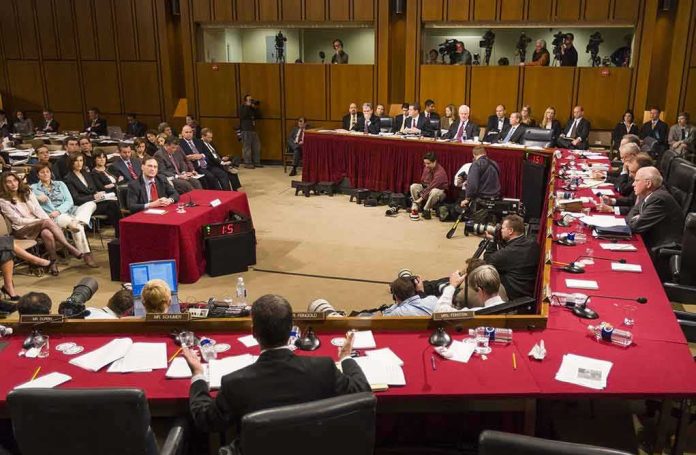
Defense Secretary Pete Hegseth told Congress the administration’s plan is a fiscally responsible, warfighting-focused budget aimed at revitalizing the defense industrial base. He said private-sector investments already exceed $50 billion, with more to come as procurement accelerates and bureaucratic hurdles fall. He framed the strategy as a response to rapid Chinese modernization, ongoing Russian aggression, and tensions involving Iran and its proxies, arguing that sustained, predictable investment is essential for readiness and technological edge [1][2].
Hegseth presented testable outputs—over 70,000 jobs and 18 million square feet of new manufacturing capacity—as evidence the industrial base will expand alongside procurement. He also emphasized acquisition reforms to cut Pentagon bureaucracy and shorten production timelines, asserting the department will partner with Congress to align priorities and ensure transparency as the funds move. The message was clear: procurement growth plus process reform will unlock private capital, speed deliveries, and harden the supply chain against adversaries [1][2].
Where The Record Is Thin And Oversight Flags Are Up
Members of Congress challenged the opacity behind the headline figure, pointing to delayed and incomplete information on munitions stocks, Ukraine-related outlays, and major program costs. They criticized a bifurcated budget structure that separates discretionary from quasi-mandatory elements, complicating accountability. Lawmakers said significant initiatives lacked full cost estimates and itemized breakdowns—an allocation posture that makes it difficult to verify what portion of the $250 billion reflects new procurement versus repackaged or forward-leaning commitments [1][2].
The hearing record did not include program-level ledgers, contract numbers, or obligation schedules that would anchor the expansion in executed actions. The jobs and factory-footprint claims arrived without independent audits, state siting records, or labor-market data to validate the scale. Without signed awards and delivery milestones, the distinction between short-term purchasing acceleration and durable capacity-building remains unclear, leaving both supporters and skeptics to argue from speeches rather than documents [1][2].
Why Big Numbers Can Confuse More Than Clarify
Telecommunications reporting offers a cautionary parallel: a recent analysis described a $250 billion “inclusive spend” that bundled fiber buildouts, fifth-generation wireless upgrades, and spectrum acquisitions into one headline figure. That kind of aggregation can be financially accurate yet still obscure timing, categories, and what truly boosts output. Defense budgets face the same risk: a single number can mix authorizations, prospective capital, and multi-year projects in ways the public hears as immediate procurement muscle when it may be phased or already planned [3].
In early 2021, the Biden administration suspended and subsequently revoked a Trump-era executive order that had banned the procurement and installation of Chinese-made electric power grid equipment, specifically targeting parts for critical defense facilities
— Tuco (@Tuco44469) May 8, 2026
For citizens worried about elite-managed budgets and revolving-door contractors, the pattern feels familiar: sweeping promises about jobs and capacity, followed by partial data and delayed disclosures. For fiscal hawks, the concern is sustainability and accountability; for civil-liberties and anti-war advocates, the concern is open-ended commitments anchored to global flashpoints. Both groups meet at a shared question: will this package deliver real factories, skilled jobs, and faster production lines, or will it mainly deliver larger balance sheets and blurrier books [1][2][3]?
What To Watch Next To Separate Signal From Noise
Independent validation will decide the narrative. Watch for detailed procurement annexes, obligation tables, and reprogramming notices that identify program identifiers, contractor awards, and delivery schedules. Track state and local records for facility openings, building permits, and payroll data to confirm the jobs and square-footage claims. Look for Government Accountability Office audits and inspector general reviews on acquisition-cycle times to test whether reforms are actually cutting months from awards and deliveries, not just promising to [1][2][3].
The deeper stakes go beyond one budget cycle. A government that earns trust shows its math, reveals trade-offs, and measures outcomes against stated goals. If the administration publishes hard ledgers linking dollars to munitions, ships, airframes, and domestic supplier growth, voters across the spectrum may see substance rather than spin. If transparency stalls, the “booming war economy” will read less like strategy and more like another headline that flatters power while the public stays in the dark [1][2][3].
Sources:
[1] Web – AT&T’s $250B network investment to advance U.S. connectivity
[2] Web – DFC Reauthorization: What’s New and What It Means