Iran’s reported bid to tax and menace ships in the Strait of Hormuz collided with U.S. resolve, as Secretary of State Marco Rubio warned Tehran that any attack on American destroyers will be met with decisive force.
Story Highlights
- Rubio says Iranian units fired on U.S. destroyers in international waters; U.S. forces returned fire defensively [2].
- Reports indicate Iran is trying to set up an agency to control and toll Hormuz traffic, which Rubio calls illegal [2][3].
- Rubio draws a red line: threats to Americans or swarming boats will be “blown up” [1][5][7].
- Claims of Iranian mines and tolls sit within a strained ceasefire and framework discussions, with limited independent verification [3].
Rubio’s Account Of The Clash And The U.S. Red Line
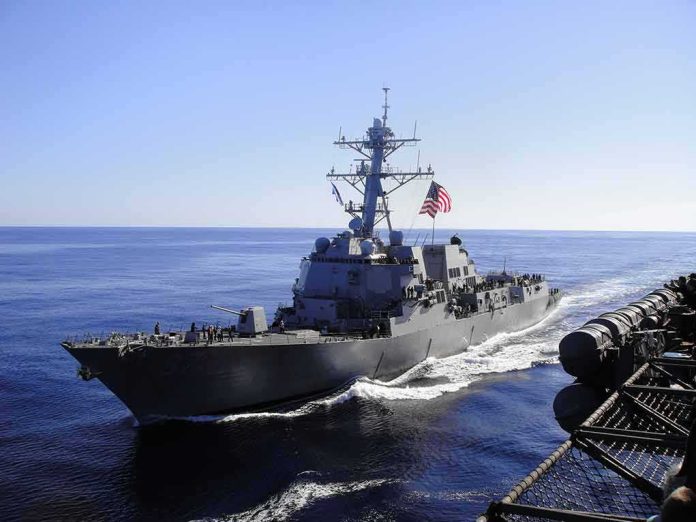
Secretary Marco Rubio stated that Iranian forces fired on U.S. Navy destroyers operating in international waters near the Strait of Hormuz and that American crews returned fire in self-defense. He framed the encounter as straightforward: if a U.S. ship is fired upon, the United States will shoot back. Rubio emphasized that only “stupid countries” fail to defend their sailors, underscoring a clear deterrent message tied to protecting freedom of navigation and American lives [2][7].
Rubio expanded the warning to include Iranian fast-boat tactics commonly used by the Islamic Revolutionary Guard Corps Navy, saying small craft that close distance on American ships will be destroyed if they pose a threat. He insisted that any operators targeting U.S. personnel will be “blown up,” signaling a rules-of-engagement posture focused on immediate defense against swarming or harassment at sea, a pattern Gulf mariners have confronted for decades [1][5].
Alleged Iranian Control Push In The Strait Of Hormuz
Rubio cited reports that Iran is attempting to establish a government agency to vet, tax, or otherwise control vessel traffic in the Strait of Hormuz, a vital waterway for global energy. He called the notion illegal and unacceptable, arguing that Tehran cannot normalize control over an international chokepoint. He pressed the international community to consider what it is prepared to do if Iran tries to impose such measures on commercial or allied shipping [2].
Coverage of ongoing talks and a framework concept referenced Iranian restrictions such as sea mines and tolls in the broader context of de-escalation proposals. Those discussions suggest that any durable arrangement would require Iran to lift such measures. However, publicly available, independently verified evidence detailing active mine placements, enforced toll schedules, or specific interdicted commercial voyages has not been presented in the cited reporting [3].
Ceasefire Strains, Operation Epic Fury, And Verification Gaps
Rubio drew a line between the defensive exchange at sea and the separate offensive campaign dubbed Operation Epic Fury, which targets Iranian missile launchers, naval assets, air power, and related factories. He maintained that the naval incident response stands apart from those broader strikes, reinforcing that the United States differentiates between immediate ship defense and strategic operations designed to degrade hostile capacity [2].
“Only stupid countries don’t shoot back when you’re shot at”
Marco Rubio, US Secretary of State, defends the US retaliation following an attack on a Navy ship, saying Iran started the confrontation and the response was warranted pic.twitter.com/CK0hAVqJKE
— TRT World (@trtworld) May 8, 2026
Reports noted a fragile ceasefire environment marked by drone and missile activity and incidents involving Iran-flagged tankers, complicating clean narratives about who escalated first at any given hour. While Rubio’s account is detailed and forceful, the public record cited so far lacks independent video, radar logs, or third-party vessel statements proving that Iranian units initiated fire against U.S. destroyers in international waters during the specific incident he described. That verification gap remains relevant for skeptics and allies alike [3].
What This Means For American Strength, Markets, And Allies
Freedom of navigation through Hormuz is non-negotiable for the United States and its partners, and any Iranian attempt to toll, mine, or commandeer the strait threatens the lifeblood of global energy markets. Rubio’s posture aligns with longstanding conservative principles: peace through strength, credible deterrence, and zero tolerance for attacks on Americans. A firm, prompt response helps prevent miscalculation, protects our sailors, and reassures shippers and insurers watching war-risk premiums climb [1][2][3].
The Trump administration now bears the responsibility to pair deterrence with clarity. That includes releasing declassified imagery or after-action data when possible, pressing allies to condemn coercive control schemes, and tightening economic and diplomatic pressure until Tehran abandons efforts to weaponize a global chokepoint. Clear evidence strengthens our case abroad, undercuts Iranian propaganda, and sustains domestic unity behind the mission to keep sea lanes open and our people safe [2][3].
Sources:
[1] US will ‘blow up’ threats against Navy ships, Rubio says
[5] US will ‘blow up’ threats against Navy ships, Rubio says – Apa.az